Saturday, October 24, 2015

100-baggers since 1962... [feedly]

----
100-baggers since 1962...
// Value Investing World

Some interesting stats and thoughts from Chris Mayer in his book 100 Baggers: Stocks That Return 100-to-1 and How To Find Them:

There are 365 stocks that have met our 100-bagger threshold since 1962. 


The 100-bagger population seems to favor no particular industry. There are retailers, beverage makers, food processors, tech firms and many other kinds. The only thing they seem to have in common is the subject of the study: they returned at least 100 to 1. 


It's also worth considering the size of these companies when they started their march. Now I hesitate to make generalizations from the statistics, as I've said. And that's why my focus is more on anecdotal evidence and the ideas or theories behind 100-baggers. With that warning, I'll add that the median sales figure for the 365 names at the start was about $170 million and the median market cap was about $500 million. 


That's interesting on two levels: One, it dispels a myth that to get a 100-bagger you have to start with tiny companies. True, these are small companies. But $170 million in sales is a substantial business in any era. It's not a tiny 50-cent stock with no revenues or barely any revenues. 


Secondly, these figures imply a median price-to-sales ratio of nearly three, which isn't classically cheap by any measure. Going through these 100-baggers, you'll find stocks that looked cheap, but more often you find stocks that did not seem cheap based on past results alone. 


So you must look forward to find 100-baggers. You have to train your mind to look for ideas that could be big, to think about the size of a company now versus what it could be. This doesn't mean you have to have a huge market to address, although that helps. Even a small company can become a 100-bagger by dominating a niche. Polaris was a 100-bagger and makes snowmobiles. 


Despite occasional exceptions, you do want to focus on companies that have national or international markets. Far more common than niche companies on the 100-bagger list are companies such as Comcast, Aflac, Dollar General, ADP and Lockheed Martin. These companies came to dominate big spaces, though they all started small. 


In 1982, Aflac had just $585 million in sales. By 2002, by which time it was a 100-bagger, Aflac had sales of $10.2 billion. Aflac's price-to-sales ratio, by the way, went from about 1.7 to 5.4. So, you had the twin engines: sales growth and multiple growth. Sales went up roughly 17-fold and the price-to-sales ratio went up roughly 3-fold. In combination, and including reinvested dividends, they worked the stock up a hundredfold. Even if we exclude the dividends, Aflac became a 100-bagger two years later, in 2004. 


Another interesting chart to look at concerns how long these stocks took to become 100-baggers. The average time was 26 years. That was also the median.


----

Shared via my feedly reader

Thursday, October 1, 2015

Tolstoy and Gandhi

In former times the chief method of justifying the use of violence and thereby infringing the law of love was by claiming a divine right for the rulers: the Tsars, Sultans, Rajahs, Shahs, and other heads of states. But the longer humanity lived the weaker grew the belief in this peculiar, God—given right of the ruler. That belief withered in the same way and almost simultaneously in the Christian and the Brahman world, as well as in Buddhist and Confucian spheres, and in recent times it has so faded away as to prevail no longer against man's reasonable understanding and the true religious feeling. People saw more and more clearly, and now the majority see quite clearly, the senselessness and immorality of subordinating their wills to those of other people just like themselves, when they are bidden to do what is contrary not only to their interests but also to their moral sense. And so one might suppose that having lost confidence in any religious authority for a belief in the divinity of potentates of various kinds, people would try to free themselves from subjection to it. But unfortunately not only were the rulers, who were considered supernatural beings, benefited by having the peoples in subjection, but as a result of the belief in, and during the rule of, these pseudodivine beings, ever larger and larger circles of people grouped and established themselves around them, and under an appearance of governing took advantage of the people. And when the old deception of a supernatural and God-appointed authority had dwindled away these men were only concerned to devise a new one which like its predecessor should make it possible to hold the people in bondage to a limited number of rulers.

And now it seems we are subjugating ourselves to bigger Ruler, the One and only and taking lives in His name!

Monday, September 28, 2015

Practicing Mind

When we practice anything properly, the fact that we are engaging in a difficult learning process not only disappears, but more importantly it dissolves into a period of inner calming that gives us a rest from the tension and anxiety that our “get it done yesterday” world pushes on us every day of our lives. For this reason, it is important to recognize and be in control of the process and to learn to enjoy that part of life's activity

I found that, when given my present moment attention, the practice sessions were very calming, not bothersome. I didn't have to be anywhere but “here,” and I didn't have to accomplish anything but exactly what I was doing “right now.” I found that immersing myself in the process of practicing would shut off all the tensions of the day and all the thoughts of what had to get done “tomorrow.”

We erroneously think that there is a magical point that we are going to get to and then we will be happy. We look at the process of getting there as almost a necessary nuisance we have to go through in order to get to our goal.When you focus on the process, the intended product takes care of itself with fluid ease.

When, instead, your "goal" is focusing on the process or staying in the present, then there are no mistakes and no judging.

Back in the mid-seventies there was a real upheaval going on in the business world of manufacturing. Everyone wanted a Japanese automobile because they were noticeably higher in quality. American auto manufacturers were scrambling to understand why this was and how to fix it. But this wasn't a situation localized in the auto industry. Japanese pianos were becoming popular in this country. Some of them had names people had never heard of and couldn't even pronounce properly, but they could see the quality difference in them regardless.

Sunday, September 27, 2015

Dhandho

  1. Score keeping is Mr. Pabrai’s most important lesson to achieve success in life and investing. Especially, the track-record is important in investing and gaming. It can help you to track your mistakes and improve your knowledge.
  2. Has read the Poor Charlies Almanac 7 times and still finds new insights.
  3. Self-improvement is the most important thing, he would bet on the guy with less knowledge and less skills if he has a drive to self-improvement, over a lifetime he will bet the guy with more skills.
  4. Pabrai thinks that Fiat is highly undervalued. Minimum margin of safety is 50% and it has the potential to become a +4x. The spinoff of Ferrari will come in less than a month and it is still not considered in the share price.
  5. Pabrai currently holds: Fiat 42% of the fund , GM B Warrents >10% , POSCO ~10% , ~15% Horsehead Holding , ~10% Google
  6. Dhando Holding IPO will be delayed by 2-3 years, they are currently developing a Smart-Beta value ETF and an own direct small businesses Insurance company (GEICO for businesses)
  7. Stone Trust made an underwriting loss of 4 million this year (when the Equity was just 61 million)
Next, I will share my takeaways from the presentation which was attended by approximately 175 guests:

Start of the presentation


In 1920 there were over 100 car manufactures in the US. It came to a bubble, 10 years later only 3 companies survived. The same happened in the 1960s with the electronic industry and in the 2000s with the internet companies.

He speaks about the “Nifty Fifty” and that investors paid any price for good business in the 1950s. At the end of the day the valuation collapsed and the stocks wend down by 75-90% (featured it in “the mosaic theory as well).
According to Pabrai we are currently seeing the “Nifty-Fifty” again. He mentions Amazon, Tesla, Solar Valley, Uber etc. all are good businesses but are valued way to high. Even the CEO of Netflix says that his stock valuation is crazy.

He compares Tesla with GM, which is currently trading at an P/E of 4x according to him.
He then compares Netflix vs. Micron: Only 3 players in the market of Micron. Micron has a market cap of just 20 Bn. And makes 3,6 bn earnings.

Pabrai has launched his fund in 1999 when he bought everything which had a discarded name. According to him, his current portfolio is quite cheap and he again holds many discarded names.

He presents a slide with the number of companies which trade at >100x P/E, we are not yet at the peak of the 2000 internet bubble but close by. But he says that we should stay away from these highly valued stocks as they are no no-brainer. Pabrai thinks that bubbles and bursts are now more frequent and happen somewhere in the world every 3-6 months.

He shows his performance: Since inception he has made 14,6% p.a. far away from his old aim of 23%, but still outperforming the index by a wide margin. He also speaks generally about the power of compounding.

He shows his 5y track record which is with 13,9% below the index (20,6%). But Pabrai doesn’t see a problem with this, as times of underperformance have to be there in accordance to outperform a market over the long run. According to him, the performance will turn around. In the last 2 month the fund lost 12% .

He then starts to talk about positions, this year he makes an exemption of his rule not to speak about current holdings.

Fiat & GM make up ~ 50% of the Portfolio. He doesn’t invest more than 10% into one position but doesn’t mind when a position grows.

The value of the Ferrari spinoff will exceed the initial purchase price of the entire position. In his opinion Fiat will not drop that much after Ferrari is spinout of Fiat. He thinks that Fiat should be at least valued 2x or even more.

GM class B warrents will participate from the share repurchase program which will be enhanced further in the future.

85% of mutual funds underperform the index due to the low fees.

Pabrai funds runs at ultra-low costs, currently he has costs of 0.08-0.04%. This is due to the fact that he pays for everything like rent personally. He mentioned that UBS is the broker for the fund and helps to achieve those low costs.

Pabrai uses a compounding hurdle rate of 6% p.a., which is set on the peak of the fund in 2007. Since than he hasn’t earned any money. If he had charged a 2/20 rate he would have earned +14 Mio., each year!!!

‘Post-mortem’

Helps to make your decisions visible and improves your process.

Sold Bank of America

He bought it at a 0,5x TBV after Buffett went into the stock. TBV (tangible Book Value) is the only metric which is appropriate for a bank investment, but you need a good management! TBV is affected by ROE/ROA. A bank like BoA should trade at a premium x1.4 TBV. Currently we can see a consolidation in the banking sector, due to the higher pressure form regulation. Accordingly, we see a disadvantage for smaller banks (he had a position in Interactive Brokers but sold out). The good thing in investing is that you can make a lot of mistakes in investing but you have to learn from them!

Sold Citi

He bought Citi at a TBV of 0.5x,

Dhandho –Holdings

IPO is delayed by 2-3 years. Raised 152 million in H1 2014 and bought Stonetrust Insurance for ~30 Mio. plus an injection of capital of 30 Mio. ~62 Mio. Equity. It recently announced an underwriting loss of 4 million!!!
Mr. Pabrai was not able to shoot a target, to expand its business, due to too high valuations.
They now try to incubate something on they own:
  1. A GEIGO for small business via internet
  2. A smart-Beta ETF
They use Puerto Rico as a base due to low costs and low taxes (only 4% tax rate), furthermore he has outsourced the IT of Stonetrust to india which is much cheaper (1/3 of the costs). According to Mr. Pabrai, the new ventures have a low downside in terms of capital and a high potential upside.
Unfortunately, I was not able to write down the questions in the Q&A as I had to stand in a line to ask my question.

Source:http://frenzel-herzing.com/dhando-investor-meeting-2015-a-day-with-mohnish-pabrai/

Sunday, September 20, 2015

Anger

The Parable of the empty boat. 🌺⛵
A monk decides to meditate alone, away from his monastery. He takes his boat out to the middle of the lake, moors it there, closes his eyes and begins his meditation. After a few hours of undisturbed silence, he suddenly feels the bump of another boat colliding with his own. With his eyes still closed, he senses his anger rising, and by the time he opens his eyes, he is ready to scream at the boatman who dared disturb his meditation.

But when he opens his eyes, he sees it's an empty boat that had probably got untethered and floated to the middle of the lake.

At that moment, the monk achieves self-realization, and understands that the anger is within him; it merely needs the bump of an external object to provoke it out of him.

From then on, whenever he comes across someone who irritates him or provokes him to anger, he reminds himself, "The other person is merely an empty boat. The anger is within me."
🙏👍

Tuesday, September 15, 2015

Cash

A man is rich in proportion to the number of things he can afford to let alone.
Henry David Thoreau

Just because the market is open does not mean you have to trade. Cash is a position too.

Friday, September 4, 2015

What QE Actually Impacted [feedly]

On why fed rate hike will have impact on asset prices
 
 
Shared via feedly // published on ValueWalk // visit site
What QE Actually Impacted

What QE Actually Impacted by Eric Bush, CFA, Gavekal Capital Blog

The Federal Reserve's balance sheet has now been relatively unchanged for about 10 months. Total asset at the Fed are about $61 billion higher than they were one year ago. It sounds like a lot but considering total assets are currently $4.48 trillion, $61 billion is a drop in the bucket.

QE


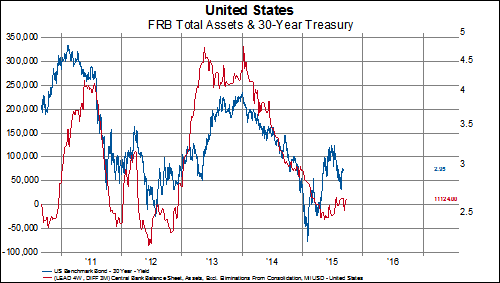
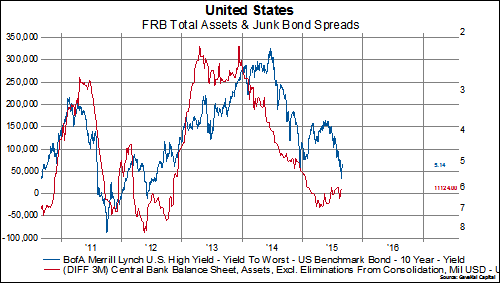
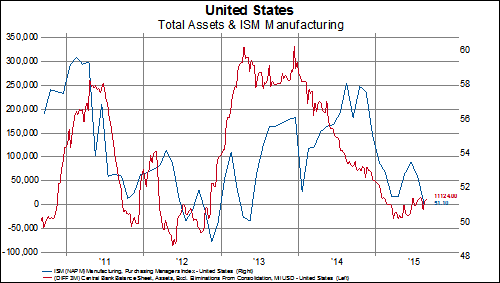
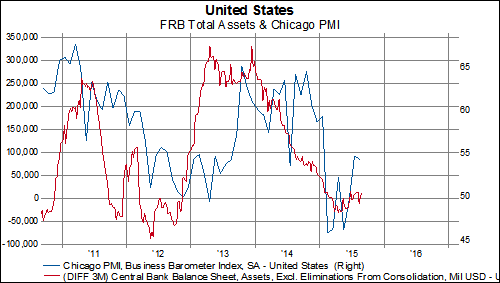
During the various QE programs in the US, a useful template to track different market and economic indicators was to plot them against the 3-month change in total Fed assets (see some of our older posts here, here, and here). Now that we have gone nearly a year since the taper ended, let's check in on some relationships.

QE certainly affected asset prices. For government bonds, yields widened as the Fed's balance sheet expanded and have narrowed as the Fed's balance sheet has stopped growing. For corporate bonds, spreads over treasury narrowed as the Fed was expanding its balance sheet and have since widened substantially as the Fed's balance sheet has stopped expanding. Breakeven inflation expectations have dropped significantly as the Fed's balance sheet has stopped growing as well.

image

image

image

image

image

Stocks were positively affected as well. The 12-month change in the S&P 500 has fairly closely tracked the 3-month change in Fed assets. Momentum in the market has also tracked the change in Fed assets.

image

image

image

image

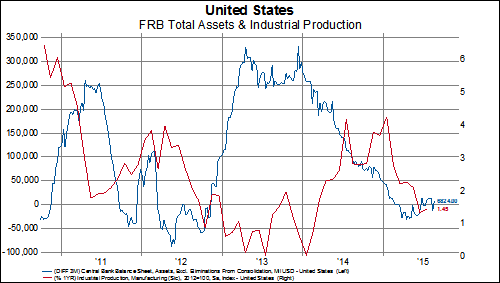
The effect on economic indicators is much more mixed. QE seems to have clearly impacted the manufacturing PMIs. However, the effect on manufacturing IP itself is tougher to discern.

image

image

image

image

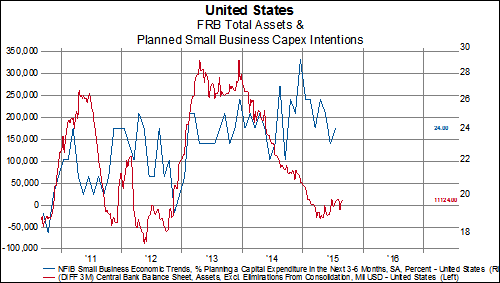
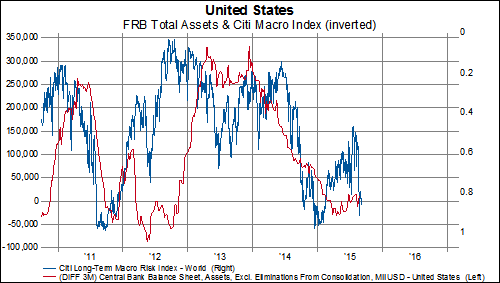
It's tough to see if QE had much effect on house prices. And it certainly didn't matter to the consumer or small business owners. However, it seems to have negatively impacted economic surprises and increased perceived macro risks in the world as it was winding down.

image

image

image

image

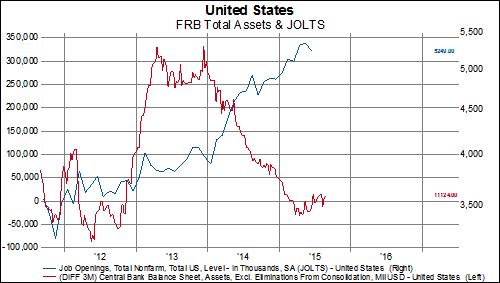
Finally, QE didn't seem to make much of a difference for nominal GDP or employment.

image

image

Unfortunately, overall it seems that QE had a much larger impact on bond and stock prices than on real economic activity. Government bond yields widened when the Fed was expanding its balance sheet while corporate spreads over bond yields narrowed. Stock prices were positively impacted by QE as well and have lost a lot of momentum since QE ended. Manufacturing surveys, in the US and globally, have been affected by QE but real economic indicators such as employment, small business intentions, and GDP have shown little relationship to changes in the Fed's balance sheet level.

The post What QE Actually Impacted appeared first on ValueWalk.


Sent from my iPad

Thursday, August 6, 2015

VSS Mani - Contrarian Streak

Mumbai: It is quite a story. More so when Venkatachalam Sthanu Subramani, 49, tells it his way, in a sing-song voice, with a slight foreign accent, keeping the suspense alive all the time.
He speaks of a time when Just Dial Ltd (JD), the company he founded, was doing well. Of a time when almost every Internet start-up in India was doing well.
He speaks of 1999.
“So one of the consulting firms approached us,” says Mani. “And said, look we can help you raise money. And you just need to have an Internet story to your business model. You know, for valuation.”
“ I wasn’t interested much but anyway, an Indian entrepreneur, who had a successful company listed on NASDAQ, approached us to buy a stake in our company. I was surprised; I’m not going to give you a name. So he came to buy. First, the entire company; and then, part of the company. And he was giving me dotcom stocks, you know, swapping. And I was, like, ‘Sorry buddy. I’m not interested’. But at every meeting, he would say, ‘Hey, the stock is worth 2X and then 3X’. Anyway, I didn’t want any of it. I was like, ‘Give me hard cash and I may give part of my company to you’.”
Eventually, that’s what some investors did—offer him cash.
“So I went to my chartered accountant and asked him, what is my company worth? You know what he said?”
No. What?
“15-20 lakh, or something like that. I was embarrassed. I was like, ‘How am I going to approach these guys and tell them that I am valued at Rs.20 lakh?’. Why would anybody buy any stake at all? So I told them, ‘Why don’t you guys throw a number, of what you are willing to pay.’ And you know what they came up with?”
He pushes on without stopping.
“A couple of million dollars. And I said, ‘What’s that? Aa..aa..aa, come again, please’. I couldn’t breathe. And then I went back and asked them for $2.5 million, almost close to $3 million and I actually got it. And I was a millionaire. In 1999. In dollar terms. I had the money in my bank; can you believe it? In just three years, from where I had no money to buy telephone lines, I had become a millionaire.”
“Now, why am I telling you all this?” he continues. “Because, these are times like that. There is a lot of glamour associated with the Internet these days. There is noise, media, valuations; but you know, in life, it is not easy to make money. To run a successful organization is not easy. You can’t throw money at a problem and run a successful organization. This whole Internet thing should not pollute young minds where they think, ‘I will come out of college, come out with an app and become a millionaire’. It doesn’t happen that way.”
It would be fair to say that Mani knows what he is talking about.
In the start-up world of private valuations, JD is a publicly listed company. As on 30 July, its market capitalization wasRs.7,600 crore. Along with his brother and wife, Mani holds 32.6% of the company’s equity, which is valued at almostRs.2,500 crore. As of July 2015, JD employed over 10, 879 people.
In 2014-15, it had a revenue of Rs.590 crore, up 27% over the previous year. The company turned in a profit of Rs.139 crore. Importantly, JD has been in business for quite a while—19 years, to be exact.
All of which means that Mani has seen India change. And there is only one way to put it; that when Mani started out, it must have been a pretty bleak world.
No phones. No Internet
VSS Mani was born at the Tata Main Hospital in Jamshedpur in 1966. Growing up in Calcutta (as the city was known back then), Mani had fairly simple and well defined goals—he would pursue a degree in commerce and chartered accountancy (CA). He attempted both, at the University of Delhi, but dropped out (of both) due to financial pressure.
It wasn’t until 1989 that the idea of Justdial first came about. Except, it had a different name and was called Ask Me. Back then, finding any information was a chore. Only two sources existed—a cumbersome book of listings arranged in alphabetical order that would be updated once a year or the government-run helpline number 197. As fate would have it, Mani was employed with a Yellow Pages company, which published one of those information directories.
“So I remember chatting with a client of mine (Rakesh Aggarwal), who wanted to be in the directory,” says Mani. “And we were like, ‘People want information; why can’t they just dial a number and get it?’ We (thought we) could do something like this. He (Aggarwal) loved the idea and after that, he was after me for months to start this business and I refused to take his calls. I was not ready to take the plunge into business.”
After a while, Mani succumbed. But right from day one, Ask Me was a non-starter. Less than 1% people in India had phone connections and getting one was like winning the lottery. Needless to say, Ask Me applied for phones but it would take years for it to come through. In certain cases, Ask Me entered the market with the promise that it would start services but didn’t because it couldn’t get a connection. “It was ridiculous,” says Mani.
In 1992, he quit, but he had been bitten by the entrepreneurial bug. Mani dabbled in a few other ventures, but they never really took off.
So, in 1994, he bid goodbye to Delhi and moved to Bombay (as the city was called back then) and started his own publication called Wedding Planner.
It was distributed (free) by the Times of India to its matrimonial advertisers. That, too, lasted a while. But, by 1995, Mani felt things had begun to change and it was time to revisit the Ask Me idea.
What changed exactly? Well, more phones and the arrival of the Internet.
“The telecom scene changed and I remember being exposed to the Internet,” says Mani. “I used to have a Business India email account. But the dial-up network was so bad. It would take minutes to get through and then it would barely last. We didn’t believe in it but we used to read a lot of articles in the papers of (the Internet’s) great success and how it was taking off in the US. Like America Online and all. But for me as an entrepreneur, I knew it would take time and I wanted to ride the telecom wave.”
So, in 1996, Mani started Justdial. In 1997, he registered the domain name www.justdial.com
Phones. Internet
“Telephone was a platform that could work for us,” says Mani. “That’s what people had access to and they could dial in a number and get information. People would call and we would actually read out the information.”
Then, in 1999, at the height of the dotcom boom, JD went online. There was a search box, where people could key in queries on products and services.
“(The) Internet took off like crazy then,” says Mani. Except, it didn’t last long. After the bust, in 2001, JD shut down its website. “Because it was resource intensive,” he says. “You needed to have a set of technology guys which was scarce and complicated. Also because we didn’t have any money and it was too risky for us because we could not monetize it (the Web). So we focused on telecom.”
While JD grew, in 2004, the firm once again flirted with the website idea. After a few months, it ran into the same problem. No monetization. Small and medium business entrepreneurs weren’t interested in paying for the website listing. So, once again, Mani put the project on hold.
JD’s telephone service business though was chugging along smoothly. As the company grew to more cities, it found interest from investors. The earliest being SAIF Partners, sometime in 2006.
Ravi Adusumalli, managing partner of SAIF Partners, remembers his first meeting with Mani.
“Several members of our team were users of the service,” he says. (The apocryphal story in investment circles speaks of a SAIF partner who was in Mumbai and wanted to find something, couldn’t, and was then advised to call JD.) “So we decided to meet Mani and understand the business better and well. The rest is history. We were sold. We loved his passion and his ability to build a real business with very little capital.” After SAIF Partners, several other investors came along, including Tiger Global.
At JD, there was enough and more money in the bank. But money wasn’t the problem; as much as how and where to spend it in cracking the Internet.
“We waited a few more years,” says Mani. “And in May 2007, we finally launched the website. Imagine, this is 10 years after registering the domain name.”
It wasn’t an easy decision to make. Even in 2007, Internet penetration in India was just about 3%. And the price of personal computers was a significant barrier to entry. But the fact that the Internet would be big was evident.
Most operators had begun offering use and pay services instead of subscriptions. Phones were also capable of connecting to the Internet, although data connection was patchy. But Mani’s biggest challenge was convincing his clients to pay for the Web. “They were like, ‘We don’t want to pay for Web because we just understand voice service’,” he says. “So we tried selling Internet separately, but barely recovered the cost of sales also. So, in 2009, I realized not to complicate this by selling voice, Web and mobile separate. I said, ‘let’s bundle everything in one and say that’s the single product from JD. Under JD, you get all of this, whether you want it or not”.”
The strategy worked.
Before long, though, other problems cropped up. The Web worked differently. It wasn’t like having customers call in and JD sending information over text and emails. There, presentation mattered. JD’s website was boring and it didn’t have any takers. People wanted pictures, videos, location-based search and directions.
“So we started working on those and, in 2009, we launched a better looking site,” says Mani. “In those days, we used to engage videographers and photographers and send them to these businesses to shoot videos and pictures, and then upload it. The content itself was not available to such businesses. Geocoding data was a challenge because it was very expensive.”
Even as all this was happening, Mani was worried. Would the Web strategy work? Wouldn’t it cannibalize his voice traffic? Was it the right decision to put out years and years of hard work (data) online and open it to competition who could just clone the JD model online? What about Google and the other Internet giants that had the potential to disrupt his business model.
“It was a big decision for us,” says Mani. “And we were deeply suspicious about the whole thing. But then, I thought through the whole thing and stuck to the strategy I’ve followed all my life. Follow the user. If the user is evolving and you don’t, then within a few years you will be outdated and lose it all.”
Needless to say, the critics were skeptical if JD would survive. They still are.
Today, there’s an app for almost any information that a person might need—buying, selling, eating out, shopping, rides, price comparisons across products and services; it is all there. But Mani believes that he has seen the back of one and too many detractors. “The outside world will be skeptical, but we just kept our focus,” he says. “And we have built JD by being profitable, growing our top line, bottom line, no freebies, no cashbacks, nothing.”
It would be fair to say that Mani comes across as a contrarian; one who doesn’t believe in the view that an e-commerce business must lose money. “JD did Rs.600 crore of revenue last year. That is equivalent to roughly Rs.60,000 crore revenue of an e-commerce company in terms of GMV,” he says. Gross merchandise value, or GMV, is a term used in online retailing to indicate total sales of merchandise through a particular marketplace over a certain time frame.
“Commerce means making money. You cannot have deep discounts; you cannot buy things for Rs.100 and sell at Rs.80. Or (give) cash back. Do not glamourize this—I have a request to the media. Try to demystify this whole space and put out the right and wrong because a lot of sharp brains are getting misguided actually.”
Is there one good reason why anyone should listen to him? Experience, perhaps.
“To a man in the industry, we are extremely worried about the way things are,” says Mani. “Today we have the talent pool. In the dotcom days, it was a big challenge. People used to join organizations at double or triple the salary. It is another matter they all lost their jobs in the next six months. They all quit big companies to join Internet companies and most of the time they used to while away in the canteen thinking of all kinds of domain names. That is exactly what is happening today. People are flirting with apps. It doesn’t work like that.”
The future: Smartphone. Apps
Mani’s cautionary tone and belief in the fundamentals of business isn’t the popular narrative of our times. What is? Growth and valuation, never mind the red on the books. Which is why, a lot rests on Mani’s idea (one which has been in the works for a while, though) of turning JD into a platform where people can transact or buy and sell, and not just be a destination for local information. The idea is called Search Plus. And it will be App led. “Any search with a commercial interest is JD,” says Mani. “You could search for a scientific apparatus, used car, used furniture, doctors or any kind of product or service under the sun.”
To be able to do that, JD is working on a lot of plans. There’s an advertising spend of Rs.100 crore which has been kept aside to coincide with the launch (which has been delayed and pushed to August), a payment gateway, a local logistics service to deliver products in a radius of 2km and a cloud-based service to its merchants to manage inventory.
Opinion in the analyst community is divided on Search Plus. The optimists believe it is the right direction for JD and will add value to shareholders. In its equity report on the company, brokerage Nirmal Bang says that JD “will benefit as people get used to online services and is the one of the few companies with bottom-line growth.”
It adds: “We believe JDL’s business model has inherent advantages over existing e-commerce players like: 1) strong database of 15mn listings, 2) strong lead generation capability because of over 1,000mn annual searches on its platform, 3) addition/update of more than 50,000 vendors on a daily basis, and 4) edge over competitors in cash collection, logistics cost, delivery time, personal touch, etc.”
Sceptics though hold the view that maybe the company is spreading itself too thin. And that compared with its peers, several of them, from OLX to Flipkart to Makemytrip to Redbus, the room to grow for JD is limited. Because, unlike the others, the company has made it amply clear that it won’t go down the aggressive discounting route.
Comparison with peers doesn’t bother Mani. “We are an old company, so we have seen various competitors,” he says. “For us, initially, the competition was the print industry, which was far more established. Run by big names like Tata Press and some bits of Times Group. We kind of killed that business model. In Web, there were many wannabes who tried it. In the horizontal space, we do not have any competition at all.”
It is a bold statement to make. But, then, Mani is a survivor. And perhaps he knows what he is talking about.
Needless to say, where JD goes from here, will be quite the story.

Lessons of history - Will Durant

At the other end of the scale history reports that "the men who can manage men manage the men who can manage only things, and the men who can manage money manage all."

It is one secret of their power that, having studied the fluctuations of prices, they know that history is inflationary, and that money is the last thing a wise man will hoard.


Wednesday, August 5, 2015

Sales

Thereby, quite unconsciously, I turned up the first principle of salesmanship--which is, that you must thoroughly believe in what you have to sell. Then selling becomes merely a matter of showing how your product will help a prospect. I have always been more of a salesman than a manufacturer--it has been hard for me to learn factory methods. But selling has always come easy to me, simply because, since those patent medicines, I have never attempted to sell anything which I did not thoroughly believe in. Therefore, I have never really had to sell at all--only to explain the favour I expected to do the prospect. The principle holds true, whether one is selling a tangible thing, like a rubber tire, or whether one is selling something intangible, like the future of the company, either in the shape of capital stock or in the shape of credit at a bank. Persuading a man to buy is not, to my notion, salesmanship. It is just persuading him to buy and nothing more. 
Salesmanship has to establish a continuing relation in which the seller helps the buyer. Going to great lengths to sell a man something he does not want is a clumsy way of trying to get money--it is much simpler and just as honest to knock the fellow on the head and take the money away from him.