July 11, 2014: On June 18, Aswath Damodaran, a finance professor at NYU’s Stern School of Business, published an article on FiveThirtyEight titled “Uber Isn’t Worth $17 Billion.” This post was a shortened version of a more detailed post he had written for his own blog titled “A Disruptive Cab Ride to Riches: The Uber Payoff.” Using a combination of market data, math, and financial analysis, Professor Damodaran concluded that his best estimate of the value of Uber is $5.9 billion, far short of the value recently determined by the market. This estimate of value was tied to certain “assumptions” with respect to TAM (total available market) as well as Uber’s market share within that TAM. And as you would expect, his answer is critically dependent on these two assumptions.
As the Series A investor and board member at Uber, I was quite intrigued when I heard that there was a FiveThirtyEight article specifically focused on the company. I have always loved the deep, structured analysis that Bill Simmons and Grantland bring to sports, and when Nate Silver also joined ESPN, I was looking forward to the same thoughtful analysis applied to a much broader range of subjects. Deep research and quantitative frameworks are sorely lacking in today’s short attention span news approach. I could hardly wait to dive in and see the approach.
The funny thing about “hard numbers” is that they can give a false sense of security. Young math students are warned about the critical difference between precision and accuracy. Financial models, especially valuation models, are interesting in that they can be particularly precise. A discounted cash flow model can lead to a result with two numbers right of the decimal for price-per-share. But what is the true accuracy of most of these financial models? While it may seem like a tough question to answer, I would argue that most practitioners of valuation analysis would state “not very high.” It is simply not an accurate science (the way physics is), and seemingly innocuous assumptions can have a major impact on the output. As a result, most models are used as a rough guide to see if you are “in the ball park,” or to see if a particular stock is either wildly under-valued or over-valued.
So here is the objective of this post. It is not my aim to specifically convince anyone that Uber is worth any specific valuation. What Professor Damodaran thinks, or what anyone who is not a buyer or seller of stocks thinks, is fairly immaterial. I am also not out to prove him wrong. I am much more interested in the subject of critical reasoning and predictions, and how certain assumptions can lead to gravely different outcomes. As such, my goal is to offer a plausible argument that the core assumptions used in Damodaran’s analysis may be off by a factor of 25 times, perhaps even more. And I hope the analysis is judged on whether the arguments I make are reasonable and feasible.
Damodaran uses two primary assumptions that drive the core of his analysis. The first is TAM, and the second is Uber’s market share within that market. For the market size, he states, “For my base case valuation, I’m going to assume that the primary market Uber is targeting is the global taxi and car-service market.” He then goes on to calculate a global estimate for the historical taxi and limousine market. The number he uses for this TAM estimate is $100 billion. He then guesses at a market share limit for Uber – basically a maximum in terms of market share the company could potentially achieve. For this he settles on 10%. The rest of his model is rather straightforward and typical. In my view, there is a critical error in both of these two core assumptions.
TOTAL AVAILABLE MARKET ANALYSIS
Let’s first dive into the TAM assumption. In choosing to use the historical size of the taxi and limousine market, Damodaran is making an implicit assumption that the future will look quite like the past. In other words, the arrival of a product or service like Uber will have zero impact on the overall market size of the car-for-hire transportation market. There are multiple reasons why this is a flawed assumption. When you materially improve an offering, and create new features, functions, experiences, price points, and even enable new use cases, you can materially expand the market in the process. The past can be a poor guide for the future if the future offering is materially different than the past. Consider the following example from 34 years ago that included the exact same type of prediction error:
“In 1980, McKinsey & Company was commissioned by AT&T (whose Bell Labs had invented cellular telephony) to forecast cell phone penetration in the U.S. by 2000. The consultant’s prediction, 900,000 subscribers, was less than 1% of the actual figure, 109 Million. Based on this legendary mistake, AT&T decided there was not much future to these toys. A decade later, to rejoin the cellular market, AT&T had to acquire McCaw Cellular for $12.6 Billion. By 2011, the number of subscribers worldwide had surpassed 5 Billion and cellular communication had become an unprecedented technological revolution.” (article via @
 The tweet included here from Aaron Levie highlights the key point we are making – Uber’s potential market is far different from the previous car-for-hire market, precisely because the numerous improvements with respect to the traditional model lead to a greatly enhanced total available market. We will now walk through those key differences, dive deep on the issue of price, and then consider a range of expanded use cases for Uber, including one that changes the game entirely.
A RADICALLY DIFFERENT EXPERIENCE
- Pick-up times. In cities where Uber has high liquidity, you have average pick-up times of less than five minutes. For most of America, prior to Uber it was impossible to predict how long it would take for a taxi to show up. You also didn’t have visibility into its current location; so having confidence about the taxi’s arrival time was nearly impossible. As Uber becomes more established in a market, pick-up times continue to fall, and the product continues to improve.
- Coverage density. As Uber evolves in a city, the geographic area they serve grows and grows. Uber initially worked well primarily within the San Francisco city limits. It now has high liquidity from South San Jose to Napa. This enlarged coverage area not only increases the number of potential customers, but it also increases the potential use-cases. Uber is already achieving liquidity in geographic regions where consumers rarely order taxis, which is explicitly market expanding.
- Payment. With Uber you never need cash to affect a transaction. The service relies solely on payment enabled through a smartphone application. This makes it much easier to use on the spur of the moment. It also removes a time consuming and unnecessary step from the previous process.
- Civility. The dual-rating system in Uber (customers rate drivers and drivers rate customers) leads to a much more civil rider/driver experience. This is well documented and understood. With taxis, users worry about being taken advantage of, and many drivers spend all day with riders accusing them of such. This can make for an uncomfortable experience on both sides.
- Trust and safety. Most Uber riders believe they are safer in an Uber than in a traditional taxi. This sentiment is easy to understand. Because there is a record of every ride, every rider, and every driver, you end up with a system that is much more accountable than the prior taxi market (it also makes it super easy to recover lost items). The rating system also ensures that poor drivers are removed from the system. Many of the women I know have explicitly stated that they feel dramatically safer in an Uber versus a taxi.
DIFFERENT ECONOMICS
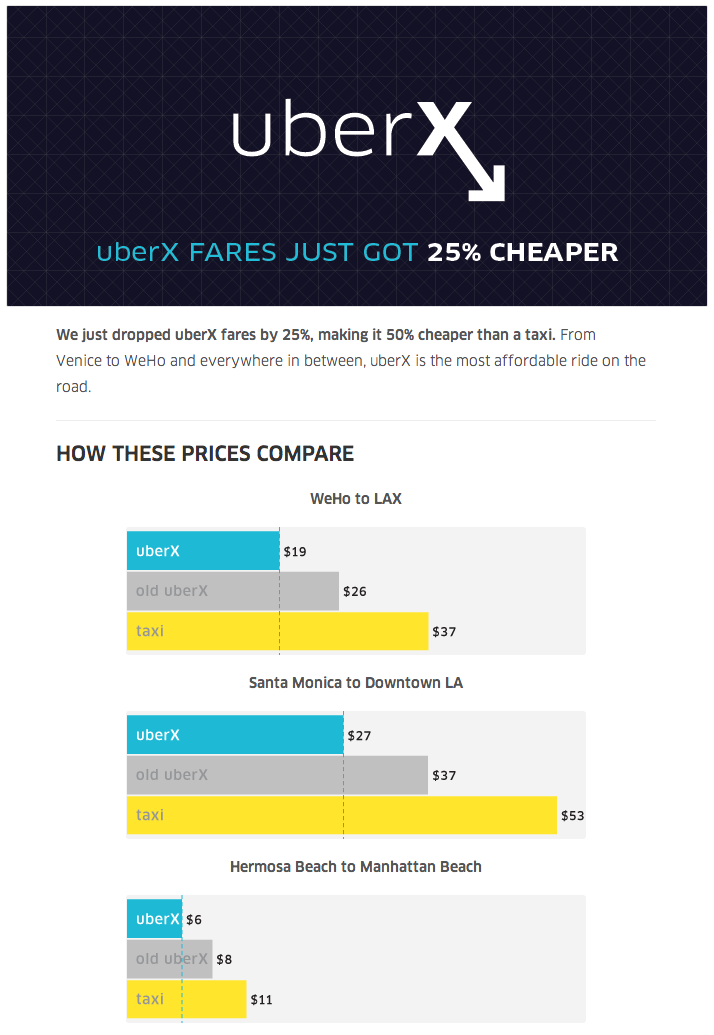
I find it surprising that a finance professor like Damodaran did not consider the impact of price on demand. As Uber becomes more and more liquid, its drivers enjoy higher and higher utilization. Utilization is a measure of the percentage of time drivers are working versus waiting. Think about rides per hour as a similar measurement. As utilization rises, Uber can lower price, and the drivers still make the same amount. Uber does in fact choose to do this, and has done it many times. Just last week, the following email went out to all users in Los Angeles (see graphic below). If you look at the bottom of the graphic, you will see that Uber is now priced dramatically below a taxi. The relationship between price and demand is well understood, and while Damodaran may not have the numbers he would need to calculate Uber’s specific price elasticity, let me assure you that it is high. This only makes sense – lowering the price of car-for-hire transportation will increase the usage.
Most taxi services in the majority of U.S. cities have a fixed supply through some type of medallion system. In NYC today there are 13,605 licensed taxis. In 1937, when the modern system was created, there were 11,787. Additionally, prices only go up, they never go down. How could one possibly know if this is the appropriate supply of taxis and an optimal price point? Doesn’t the high-value of medallions (over $1mm in some markets) implicitly prove that the market is undersupplied and that prices are above true market clearing prices? What if someone could run a more convenient, safer service at a much lower price and with much higher availability? You would end up with dramatically more rides – and that is exactly what is happening.
NEW USE CASES
- Use in less urban areas. Because of the magical ordering system and the ability to efficiently organize a distributed set of drivers, Uber can operate effectively in markets where it simply didn’t make sense to have a dense supply of taxis. If you live in a suburban community, there is little chance you could walk out your door and hail a cab. And if you call one of the phones, it is a very spotty proposition. Today, Uber already works dramatically well in many suburban areas outside of San Francisco with pick up times in less than 10 minutes. This creates new use cases versus a historical model.
- Rental car alternative. When I used to travel to Los Angeles and Seattle on business I would use a rental car. Today I only Uber. It is materially better. I do not have to wait in lines, and I avoid the needless bus rides on each end of the trip. I don’t have to map routes. I don’t have to find parking. I don’t have to pay for parking. The rental car market is $27B in the U.S. The global market would obviously be much larger. And you are also eating into the parking market here.
- A couple’s night out. The liquidity is so high in the San Jose Peninsula that a couple living in Menlo Park will Uber to a dinner in Palo Alto (perhaps 3 miles away) to avoid the risk of driving after having a glass of wine. This was not a use case that existed for taxis historically. It’s also great for getting from San Francsico back home to the suburbs after a night on the town. This was a historic black car market, but the ease and convenience greatly increases the number of times it is now done, by a multiple.
- Transporting kids. An article in the New York Times titled “Mom’s Van Is Called Uber” suggests that parents are using Uber to send their kids to different events. I don’t think very many people put young kids into taxis (due to trust), but they are quite comfortable doing this in an Uber. It is also common for parents with teenagers to encourage taking Uber when they go out, to reduce the risk that they end up in a car with someone who may have been drinking.
- Transporting older parents. I know many people who are looking after older parents, who have insisted their parents put Uber on their phones to have an alternative to driving at night or in traffic. Convincing them to use Uber is much easier a task than suggesting they call a taxi due to both convenience, ease of use, and social acceptance.
- Supplement for mass transit. If you are someone who primarily uses mass transit, you are likely to consider UberX (low price offering) for exceptions such as when you just miss a train, or when you might be late for a meeting. Lower price points than a taxi and more reliability make this possible. A study from the city of San Francisco argues that more taxis will result in more mass transit use, as it makes it easier not to need a car.
THE GAME CHANGER: UBER AS A CAR-OWNERSHIP ALTERNATIVE
Damodaran likely never considered this possibility: Could Uber reach a point in terms of price and convenience that it becomes a preferable alternative to owning a car? Farhad Manjoo wrote a compelling piece for the New York Times (“With Uber, Less Reason to Own a Car”) making just this argument. And Gregory Ferenstein at VentureBeat dove a little deeper in terms of the math of how this would work. According to Ferenstein, “AAA estimates that the average cost of car ownership per year is about $9,000.” If you take that number and divide it by your average Uber fare you can calculate number of rides you could afford a year, and compare that with what you need. For many, the math is already working. I know numerous people who have already given up their cars, and several people have anecdotally sent photos to Uber of the check they received for selling their car.
Some interesting demographic trends are also underway that favor Uber’s opportunity in this market. First, there is the continuing trend ofurbanization in America. But more importantly, America’s youth have fallen out of love with the notion of owning a car. Kids are no longer rushing to obtain their license on the day they turn 16, and according to Edmunds, car ownership among 18-34 year olds has fallen a full 30% in recent years. Here are just a few of many articles published over the past two years on this topic:
- Why Don’t Young Americans Buy Cars? The Atlantic (3/25/12)
- Young Americans ditch the car CNN (9/17/12)
- The End of Car Culture The NYTimes Sunday Review (6/23/13)
- Young Americans Are Abandoning Car Ownership and Driving The Daily Beast (7/5/13)
- The Auto Industry’s Hard Sell to Convince Your Kids They Need a Car Time (1/24/14)
- Millennials Don’t Care About Owning Cars, And Car Makers Can’t Figure Out Why Fast Company (3/26/14)
There are two other points worth considering with respect to Uber as a car ownership alternative. First, the consumer is most likely to replace their “extra” car first. You may see an urban family going from two cars to one. Or perhaps a suburban family will reduce its fleet from four to three or three to two. The fixed costs of this marginal car are very high (DMV registration, insurance, depreciation), yet the usage of that car is much lower. The second point worth nothing is that for certain people the benefits of not driving are so high that they will switch to Uber before the economic case is specifically advantageous, choosing to pay a premium for the convenience. This would include people that consume alcohol after work and do not want to risk driving, people that are frequent users of smartphones when they commute (now considered a bigger risk than DUI), and people that loathe spending time parking their vehicle.
HOW BIG IS THE CAR-OWNERSHIP-ALTERNATIVE MARKET?
- According to this NADA report, total dealership sales (including service) is about $730 billion annually. However, that really isn’t what car replacement is all about. Car replacement includes all the costs of owning a car – not just the car purchase, but also insurance, DMV registration, parking, gasoline, repairs, oil changes, etc.
- The number of cars in circulation in the world is just over 1 billion, with 25% of those in the United States. AAA estimates that the average annual cost of owning a car is $9,000. While this number may seem high, if you read the report you will see that the key drivers: the rising costs of gasoline and raw materials and insurance alone averages $1000/year. It is hard to imagine a scenario where these costs fall (most are rising), and many of these costs are now consistent on a global basis. But we will conservatively cut that number by 33% to $6,000.
- One billion global cars multiplied by a $6,000 annual cost of ownership results in a $6 trillion market for annual car ownership costs. How much of that market Uber can take is an interesting question to ponder (which we will), but the fact that 25% of that market is in the U.S. is a huge advantage for the company.
Driving home the point – Uber’s potential market is far different from the previous for-hire market precisely because the numerous improvements over the traditional model lead to a greatly enhanced TAM.
WHY ONLY 10%?
Now let’s turn our attention to the 10% maximum market share number that Damodaran chose for his analysis. He argues that regulatory restrictions and competition will limit Uber’s market share. He also makes the point that there are no advantages that cross from city-to-city, a point we will dispute later.
Eighteen years ago, Brian Arthur published a seminal economic paper in the Harvard Business Review titled, “Increasing Returns and the Two Worlds of Business.” If you have not read it, I highly recommend that you do. His key point is that certain technology businesses, rather than being exposed to diminishing marginal returns like historical industrial businesses, are actually subject to a phenomenon called known as “increasing returns.” Gaining market share puts them in a better position to gain more market share. Increasing returns are particularly powerful when a network effect is present. According to Wikipedia, a network effect is present when “… the value of a product or service is dependent on the number of others using it.” In other words, the more people that use the product or service, the more valuable it is to each and every user.
So the right questions are, “is Uber exposed to some form of network effect where the marginal user sees higher utility precisely because of the number of previous customers that have chosen to use it,and would that lead to a market share well beyond the 10% postulated by Damodaran?”
There are three drivers of a network effect in the Uber model:
- Pick-up times. As Uber expands in a market, and as demand and supply both grow, pickup times fall. Residents of San Francisco have seen this play out over many years. Shorter pickup times mean more reliability and more potential use cases. The more people that use Uber, the shorter the pick up times in each region.
- Coverage Density. As Uber grows in a city, the outer geographic range of supplier liquidity increases and increases. Once again, Uber started in San Francisco proper. Today there is coverage from South San Jose all the way up to Napa. The more people that use Uber, the greater the coverage.
- Utilization. As Uber grows in any given city, utilization increases. Basically, the time that a driver has a paying ride per hour is constantly rising. This is simply a math problem – more demand and more supply make the economical traveling-salesman type problem easier to solve. Uber then uses the increased utilization to lower rates – which results in lower prices which once again leads to more use cases. The more people that use Uber, the lower the overall price will be for the consumer.
David Sacks of Yammer and Paypal, recently tweeted a napkin-sketch captioned, “Uber’s virtuous cycle. Geographic density is the new network effect” that succinctly highlights the points just mentioned.

Uber also enjoys economies of scale that span across city borders. Many people who travel have experienced Uber for the first time in another city. When the company enters a new city they have the stored data for users who have opened the application in that area to see if coverage is available. These “opens” represent eager unfulfilled customers. They also have a list of residents who have already used the application in another city and have a registered credit card on file. This makes launching and marketing in each additional city increasingly easier.
There are other economies of scale that come with being the market leader. When you consider that Uber is partnering with smartphone vendors, credit card companies, car manufacturing companies, leasing companies, and insurance companies, you can imagine that being larger is a distinct advantage. As an example, on May 28thUber announced a partnership with AT&T to embed Uber on all its Android phones. Then on June 9th, they announced a partnership where American Express users will get 2X loyalty points on all Uber rides. Additionally, Membership Rewards users can use those points to pay for rides directly in the application. It is also easy to imagine a future where Uber drivers receive discounts on things like leases, gasoline and car repair. Scale clearly matters for these types of opportunities.
UNDISCOVERED CLUES
There are clues to be found, if you know where to look. In this video recorded in October of 2012 (about 20 months ago), Uber’s CEO, Travis Kalanick, notes that when Uber launched its services in 2010 there were about 600 total black cars in San Francisco. At the time of this video, Travis notes that more than 600 black cars were active on Uber and the company was still growing at 20% month over month (at the time, UberX had just launched, so Uber’s fleet was all black cars). So 20 months ago in San Francisco, Uber was already at 100% of Damodaran’s historic market, and growth was still tilting up and to the right. The only way this is possible is if the market is expanding at rapid pace, beyond the historical limit.
More recently in a WSJ interview dated June 6, 2014, Travis notes “When we got this company started (in 2009) we were pitching the seed round and we pulled a bunch of research from this report that showed that San Francisco total spend on taxi and limo was like 120 million bucks. But we’re a very healthy multiple bigger than that right now, just Uber in SF. So it’s not about the market that exists, it’s about the market we’re creating.” He then goes on to note that the San Francisco market for car ownership is closer to $22 billion. So today, less than two years after the video, he is highlighting that Uber’s San Francisco revenues are a “healthy multiple” bigger than the historic market for both limousines and taxis. And Uber is still growing quite nicely in that market. Plus there are other competitors in the market. So Damodaran’s math simply does not hold up. This cannot be yesterday’s market.
There is another quite simplistic methodology that might have helped Professor Damodaran avoid his unnecessary error. He could have simply asked his friends that were moderate to heavy Uber users the following question: “How does your current annualized Uber expenditures compare to your spend on taxis plus limousines two years ago?” For most of the people I know, the answer to this question is somewhere north of three times as large. That data point alone implies that this is an entirely new market.
OUR PROPOSED ESTIMATES (25X)
So now let’s consider scenarios whereby Uber’s potential market could be 25 times higher than Damadoran’s original estimate. His original estimate was based on Uber topping out at 10% of a $100 billion market. We would argue, for the reasons included herein, that the features and functions of Uber’s new car-for-hire service significantly expands the core market. Based on San Francisco alone, it appears that that market is already potentially 3X the original. For two reasons, I would consider this 3X market multiplier the low end of the range. First, Uber is still growing aggressively in San Francisco, so this new market is far from saturated. Also, when you consider that these services are succeeding in areas where taxis were previously not prevalent, this would imply a higher multiplier as well. In our model below, we assume that the expanded car-for-hire market is 3-6X bigger than the historic market.
Now we consider Uber-like services as a car ownership alternative. This trend is just beginning, but because of the points highlighted herein, we believe this to be a real opportunity. For our model, we assume that Uber-like services will encroach on a mere 2.5%-12.5% of this market. This represents a potential opportunity of $150-$750 billion depending on how aggressively one believes these services can succeed as a car alternative.

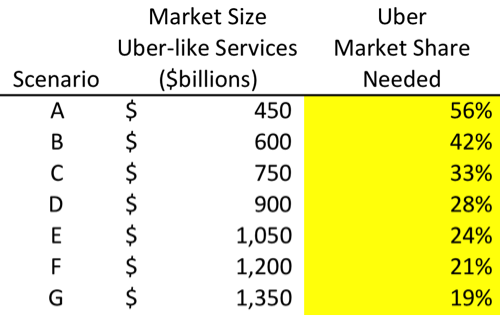
Combining these two opportunities, you end up with a potential range of new TAM estimates from $450 billion all the way up to $1.3 trillion. Now we calculate the market share Uber would need against these new TAM estimates to arrive at an opportunity that is 25X that of Damadoran’s $10B. The table below shows those estimates. In the most bearish case (Scenario A) where the expanded market opportunity is capped at 3X and these new services only marginally impact car ownership, Uber would need a market share of 56%. Arguably it already has that share today, and this number is not unreasonable in a world of network effects (a point that Damadoran cedes in a more recent post). In the case I think is more likely (Scenario G), the expanded market multiplier is 6X and you see a 10% impact on global car ownership, Uber’s market share need only be in the 20% range. Once again, the fact that the U.S. represents 25% of the car-ownership market adds more likelihood to Uber’s ability to capture that opportunity.
As discussed up front, the key objective of this exercise is to present a reasonable and plausible argument that Uber’s market opportunity might be 25X higher. Interestingly, this case is made without any consideration for whether Uber can impact the logistics market or expands into any incremental services whatsoever. We have simply taken a structured look at how traditional human car transportation can change as a result of today’s technology.
There are many biases that can come into play when making estimates. For example, as an investor and board member at Uber one might conclude that I am biased to see things in a more positive light. That would only make sense. In the conclusion to his original post, Damadoran made a similar argument, “it is worth remembering that even smart investors can collectively make big mistakes, especially if they lose perspective.” Somewhere in the editing process between Damadoran’s original post on his web site, and the version that ended up on FiveThrityEight, this little nugget was left out:
“As I attempt to attach a value to Uber, I have to confess that I just downloaded the app and have not used it yet. I spend most of my of life either in the suburbs, where I can go for days without seeing a taxi, or in New York City, where I find that the subways are a vastly more time-efficient, cheaper and often safer mode of transportation than taxis.”