Value investing in India, applying principles of Buffett, Phil Fischer and other great investors. An attempt to discover undervalued stocks that can generate above average returns combining fundamental and technical analysis
Monday, July 27, 2015
Giving
Sunday, July 26, 2015
Entrepreneur's Library: Books to develop key skills ANDREI KOLODOVSKI
Core Entrepreneurial Skills
Start-up building
- The Art of Start: Time-Tested, Battle-Hardened Guide for Anyone Starting Anything: Guy Kawasaki
- The Startup Owner's Manual: The Step-By-Step Guide for Building a Great Company: Steve Blank
- The Founder's Dilemmas: Anticipating and Avoiding the Pitfalls That Can Sink a Startup: Noam Wasserman
- Start Your Own Business: The Only Start-Up Book You'll Ever Need
Discovering & Validating opportunities
- Where Good Ideas Come From: Steven Johnson
- The Idea Hunter: How to Find the Best Ideas and Make them Happen: Andy Boynton
- Will It Fly? How to Know if Your New Business Idea Has Wings Before You Take the Leap: Thomas McKnight
- The New Business Road Test: What entrepreneurs and executives should do before writing a business plan: John Mullins
- If You Build It Will They Come: Three Steps to Test and Validate Any Market Opportunity: Rob Adams
Business Planning
- The Plan-as-You-Go Business Plan: Tim Berry
- Anatomy of a Business Plan: Linda Pinson
- Business Model Generation: A Handbook for Visionaries: Osterwalder
Funds Raising
- Raising Venture Capital for the Serious Entrepreneur: Dermot Berkery
- Venture Deals: Be Smarter Than Your Lawyer and Venture Capitalist: Feld
- Term Sheets & Valuations - A Line by Line Look at the Intricacies of Term Sheets & Valuations: Alex Wilmerding
Selling & Marketing
- Secrets of Question Based Selling: Thomas Freese
- Value-Added Selling : How to Sell More Profitably, Confidently, and Professionally by Competing on Value, Not Price: Tom Reilly
- Crossing the Chasm: Marketing and Selling Disruptive Products to Mainstream Customers: Geoffrey Moore
Innovation & Product development
- Innovation on Demand: New Product Development Using TRIZ: Victor Fey
- The Art of Innovation: Lessons in Creativity from IDEO: Tom Kelley
- Prototyping: A Practitioner's Guide: Todd Zaki
Team building
- The Entrepreneur's Guide to Hiring and Building the Team: Ken Tanner
- Teamwork: What Must Go Right/What Can Go Wrong: Carl Larson
- Boost Your Hiring I.Q.: Carole Martin
- Smart and Gets Things Done: Concise Guide to Finding the Best Technical Talent: Joel Spolsky
Finance
- Financial Intelligence for Entrepreneurs: What You Really Need to Know About the Numbers: Karen Berman
- Pro Excel Financial Modeling: Building Models for Technology Startups: Tom Sawyer
Entrepreneurial Personality
Entrepreneurial Attitude
Self-Awareness & Personal Development
Discipline & Will Power
- The Willpower Instinct: How Self-Control Works: Kelly McGonigal
- Self-Discipline in 10 days: How To Go From Thinking to Doing: Bryant
Inspiration & Motivation
- Founders at Work: Stories of Startups' Early Days: Jessica Livingston
- Losing My Virginity: How I Survived, Had Fun, and Made a Fortune Doing Business My Way: Richard Branson
- Against the Odds: James Dyson
Interpersonal Skills
Emotional Intelligence
- Emotional Intelligence: Why It Can Matter More Than IQ: Daniel Goleman
- The Other Kind of Smart: Harvey Deutschendorf
Leadership skills
Persuasion, Influence, Negotiation skills
- Influence: The Psychology of Persuasion: Robert Cialdini
- Getting to Yes: Negotiating Agreement Without Giving In: Roger Fisher
- Negotiating Rationally: Max Bazerman
Networking skills
Communication skills, Presenting and Public speaking
- Say It with Presentations: Gene Zelazny
- The Naked Presenter: Delivering Powerful Presentations: Garr Reynolds
Execution
Decision-Making
- The Effective Executive: The Definitive Guide to Getting the Right Things Done: Peter Drucker
- The Truth About Making Smart Decisions: Robert Gunther
Time & Project management
- Eat That Frog: 21 Great Ways to Stop Procrastinating: Brian Tracy
- The 7 Habits of Highly Effective People: Stephen Covey
- The Procrastinator's Guide to Getting Things Done: Monica Ramirez
Energy & Mood management
Friday, July 24, 2015
Antony Bolton - Investing against the tide
Cash generation is the key
- Management talk
Tuesday, July 14, 2015
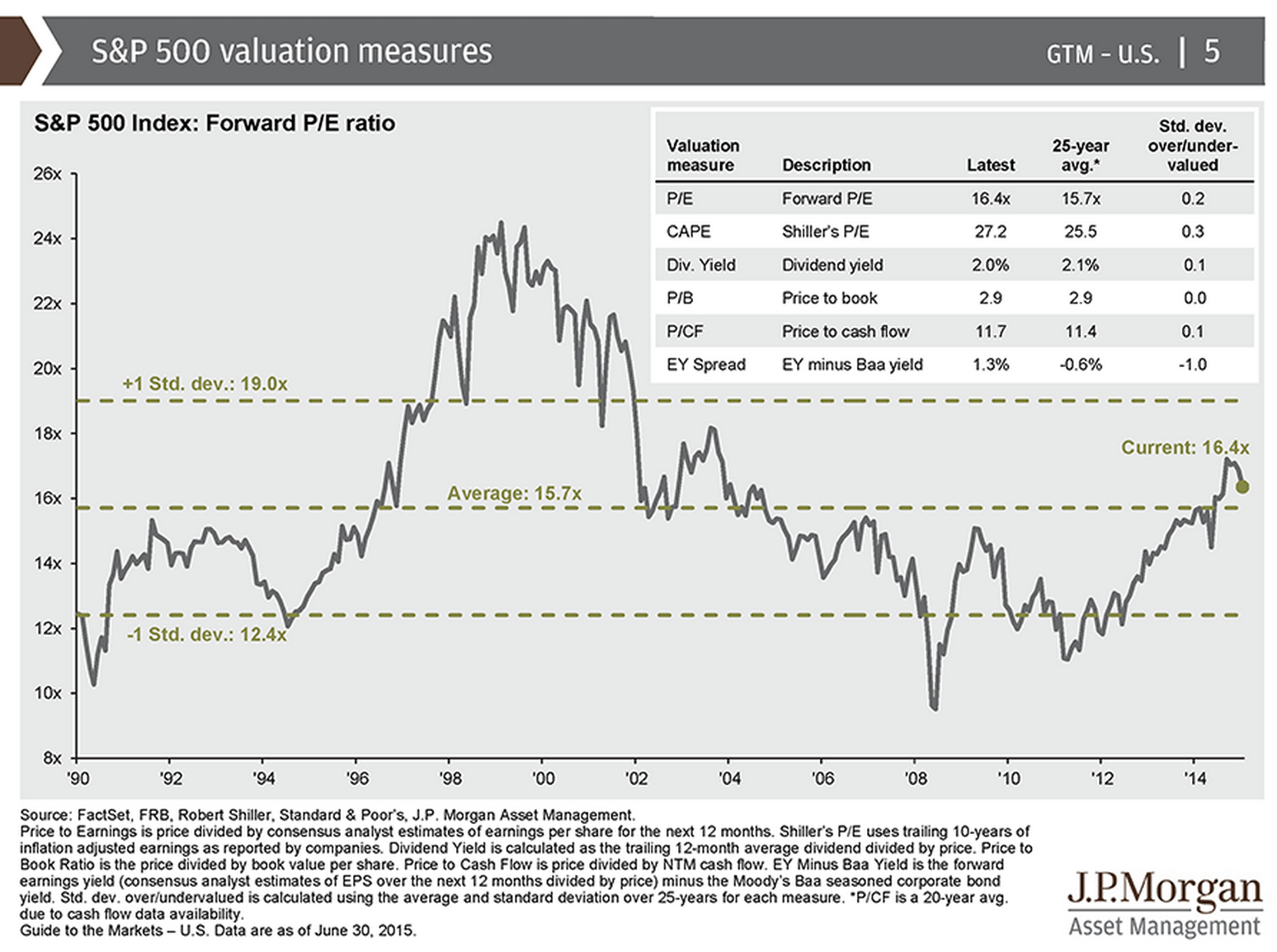
S&P 500 Performance and Valuation
Source: JP Morgan
Sent from my iPad
Thursday, July 9, 2015
Singleton
Tuesday, June 30, 2015
Rule of Three - K Ganesh
- follow the rule of three - whatever the entrepreneur presents, it will normally take three times the capital, three times the effort and three times the time
Saturday, June 27, 2015
Soros
The great trades don’t require predictions. The Soros trade of going short the pound in 1992 was based on something that had already happened—an ongoing deep recession that made it inevitable that the U.K. would not maintain the high interest rates required by remaining in the ERM. Afterward, everyone said, “That was incredibly obvious.” Most of the great trades are incredibly obvious. It was the same in late 2007. In my mind, it was clear that the financial system was imploding and that most market participants hadn’t noticed.
Historically, what is important to the market is not whether growth is good or bad, but whether it is getting better or worse. Growth started getting less negative, and less negative is good news.
And the other 90 percent?
Implementation and flexibility. You need to implement a trade in a way that limits your losses when you are wrong, and you also need to be able to recognize when a trade is wrong. George Soros has the least regret of anyone I have ever met. Even though he will sometimes play up to his public image as a guru who knows what is going on, it is in no sense what he does as a money manager. He has no emotional attachment to an idea.
Monday, June 22, 2015
more money than Gods
- Global macro trading is far more difficult and riskier (capital at loss) proposition than equity investing
- Central bank actions are the key catalysts along with deteriorating macro
- Leverage is the key element which magnifies returns both on positive and negative sides; all currency trades were levered up atleast 15 x
- Soros' strategy is not replicable, enormous amount of risk taking ability putting 40% of capital at risk with high leverage;
- Pound short was famous - Key elements
were currency peg which was unsustainable + recessionary conditions in UK i.e.
at a time when real interest rates had to be reduced; artificially high exchange
rate without a control on monetary policy and Germany was to decrease the
interest rates i.e. outsourced monetary policy because of a currency peg
- Current, greek situation seems ditto
- Druckenmiller always combined fundamentals with technicals and was good at finding out inflexions in the economy - trend following helped him incur less losses than Julian Robertson (tiger capital )in dotcom meltdown
- Julian Robertson was more fundamental and did not believe in technicals - Equity portfolio was stellar compared to his currency bets which went wrong along with the LTCM crisis
- Some portion short in the portfolio thru futures could save alpha during downturns
- Julian Roberston's strategy is replicable (barring the currency stuff) and is more in-line with fundamental investing - Chapter on him is worth reading
- Paulson MBS short seemed like a one time event and again replicability is questionable
- Each one of the greats played to their temperament
Sunday, June 21, 2015
Karna
Krishna, turned two mountains into gold.
Then said, "Arjuna, distribute these two gold mountains among villagers, but you must donate every bit of it ".
Arjuna went into the village, and proclaimed he was going to donate gold to every villager, and asked them to gather near the mountain. The villagers sang his praises and Arjuna walked towards the mountains with a huffed up chest.
For two days and two nights Arjuna shovelled gold from the mountain and donated to each villager. The mountains did not diminish in the slightest.
Most villagers came back and stood in queue within minutes. Now Arjuna was exhausted, but not ready to let go of his Ego, told Krishna he couldn't go on any longer without rest.
Then Krishna called Karna and told him to donate every bit of the two gold mountains.
Karna called the villagers, and said "Those two Gold mountains are yours. " and walked away.
Arjuna sat dumbfounded. Why hadn't this thought occurred to him?
Krishna smiled mischievously and told him "Arjuna, subconsciously, you were attracted to the gold, you regretfully gave it away to each villager, giving them what you thought was a generous amount. Thus the size of your donation to each villager depended only on your imagination.
Karna holds no such reservations. Look at him walking away after giving away a fortune, he doesn't expect people to sing his praises, he doesn't even care if people talk good or bad about him behind his back. That is the sign of a man already on the path of enlightenment".
Sent from my iPhone
Friday, June 19, 2015
Bridge water
Sent from my iPad
Tuesday, June 16, 2015
Dow theory
The age-old Dow Theory gets a mention in the latest issue of Grant's. According to Grant's it is the only reliable way of measuring US economic growth. (Grant's argues that as traditional methods of measuring economic growth don't seem to be influencing Federal Reserve policy decisions, perhaps due to concerns about the data, Dow Theory is a more reliable indicator.)
According to the Theory, when the Dow Industrial and Dow Transportation index move in lockstep, economic strength is showing through. However, when the two indexes move apart, the implications are concerning. Year to date, the DJTA is lagging its industrial peer by 6.3%. What's more, while the DJIA sits only 1.5% below its all-time high printed earlier this year, the DJTA is around 11% below its all-time high reached at the end of last year. It's not just enough to monitor the two indexes on a daily or even monthly basis.
Movement or divergence must be observed over a lengthy period. As the logic follows, if there is to be a valid increase in consumption, manufacturing and production, there will also be an accompanying increase in shipping and transportation. There's a case of extreme divergence between the two indexes. The DJTA is, in fact, breaking down at six-month lows -- one of the widest divergences in Dow Theory's history.
Dow Theory: Still Relevant?
Grant's goes on to discuss the relevance of Dow Theory in today's market. During 1999, when the DJIA reached a new high, will the DJTA lagged, few were concerned. The world was changing, and there was no longer a need for industrial companies. The world economy was being driven by asset light, cash generative tech companies. A bear market followed six months later. The same scenario took place during 2007. In this case, the DJTA moved to a new high, which wasn't confirmed by the DJIA.
Still, when Dow Theory was initially conceived (before the 1913 Federal Reserve Act), few ever thought that the Fed would embark on a money printing binge that has sustained a rally the likes of which the market has only ever seen twice since 1929 (1990 to 1997 and 2003 and 2007).
Concerning data
The divergence between the DJIA and DJTA highlights underlying economic trends. A June 3 report from the Association of American Railroads showed that during the first quarter, total rail volumes across the US fell by 0.6% year on year during the first quarter. During May, BAML analysts noted that their truck shipment survey fell to 60.7, a year-on-year decline of 11%, the ninth consecutive year-on-year decline.
Other data also supports the fact that the index divergence could be a sign that a correction is just around the corner. For example, M&A activity hit a new all-time highlast month, the same happened during 2000 and 2007. Merger wars often lead to a decline in equity prices soon after the peak.
Only time will tell if all of these indicators are indeed warning of an imminent crash.