Wednesday, February 11, 2015

Reading slowed down

In my whole life, I have known no wise people (over a broad subject matter area) who didn't read all the time — none. Zero. You'd be amazed at how much Warren reads — and how much I read. My children laugh at me. They think I'm a book with a couple of legs sticking out."

Charlie Munger, American business magnate

If there's one thing that unites the world's most successful people, from billionaires to top scientists, it's this: they read. A lot.

Warren Buffett says, "I just sit in my office and read all day." Up to 80% of his time is spent reading and thinking. Buffet says that through reading hundreds of pages a day his knowledge builds up, much like compound interest.

Elon Musk is another famously voracious reader. "He would go through two books in one day," says Elon's brother, Kimbal. Though Musk has degrees in Physics and Economics, he is self-taught in aerospace and automotive engineering, the two primary concerns of his companies, SpaceX and Tesla.

You know, whenever anybody asks Elon how he learned to build rockets, he says, 'I read books.' Well, it's true. He devoured those books.

Jim Cantrell, Aerospace consultant, on Elon Musk

Oprah Winfrey is famous for her lifelong love of reading. She says she has been a passionate reader since the age of three, and credits books with spurring her to rise above her circumstances to something greater.

Books were my pass to personal freedom. I learned to read at age three, and soon discovered there was a whole world to conquer that went beyond our farm in Mississippi.

Oprah Winfrey

Bill Gates fans have come to anticipate his yearly blog posts listing the best books he read that year. Gates' reading list is wide-ranging and spans both fiction and non-fiction books, from The Rosie Effect by Don Tillman to Capital in the Twenty-First Century by Thomas Piketty.

"I really had a lot of dreams when I was a kid, and I think a great deal of that grew out of the fact that I had a chance to read a lot."

Bill Gates

The names I've mentioned so far are famous for their reading habits. Yet, even a broader selection of high achievers—in this case, self-made billionaires—reveals a common love for reading. Across the 14 entrepreneurs profiled in this Forbes article, those interviewed read an average of 2.6 hours per day, not including email or other correspondence. By contrast, the average American spends only 19 minutes a day reading.

Though time spent reading is one factor, what these people read is also telling. In most cases they are 'Reading to Lead', devouring books (as opposed to articles, magazines, and social media posts) on challenging topics, by challenging authors.

Reading a book is the closest we can come to sharing the mind of a great thinker. After all, what is a book but thoughts transcribed? Spend a lot of time with great people and we cannot help but be transformed by the experience.

If you want to become a more interesting person, with a broader base of knowledge, more enlightened opinions, a vocabulary that expresses the nuances in how you see and experience the world, then reading well is a wonderful shortcut.

Read widely. Wide readers are able to stitch together disparate ideas from varied fields in ways that seem new.

Slow down: read to absorb, not to finish quickly. If you're looking for something to read, choose something that seems difficult. To read difficult books, you're going to need to slow down, to pause, to highlight, to take notes.

Read fiction, too. Elon Musk has been deeply inspired by the works of science fiction visionaries like Isaac Asimov, Frank Herbert and Iian M. Banks. Reading fiction makes you better at imagining what doesn't exist (yet). Reading literary fiction also improves empathy.

"A reader lives a thousand lives before he dies, said Jojen. The man who never reads lives only one."

George R.R. Martin, A Dance with Dragons

Read books. Reading a blog post or article is like being briefly dunked in an idea. A book is like being steeped in it. If you've ever wondered why you read a great blog post, decide to make a change or start practicing a new technique as a result, but then swiftly go back to your old ways, it's because you haven't had time to truly be steeped in its ideas. Blog posts sit with you for minutes, while books envelop you in their ideas for hours: about how long it takes for something to really stick.

Read to emulate. If you want to be more like someone you admire, a simple first step is to read what they read. You'll be exposed to the people and ideas that have influenced them the most.

A person's reading list is, in many ways, a portrait of who they are.

What will you read next?

Elon Musk's Reading List

Musk is a constant reader, and this represents just a small selection of books he has publicly spoken about reading. And yet, the books present a fitting portrait of the man: the inventor, the industrialist, the high achiever, the futurist, the man who believes he is trying to save the world.

While the books on a person's reading list suggest something about who they are, the books that are missing may say something about who they are not.


Sent from my iPad

Sunday, February 1, 2015

The Psychology of We


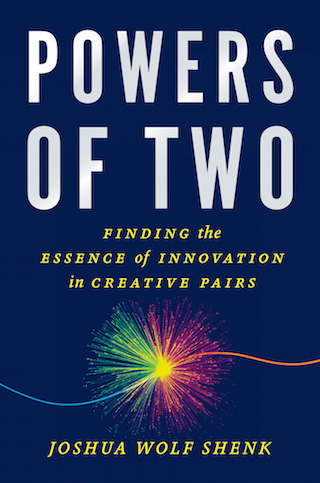
powers of two
Two categories of people that can be hard to have a conversation with are good friends and people who have worked together for a long time. Sometimes it’s like they are speaking their own language — and they are. But these connections can transcend conversation and touch on life.
In Powers of Two: Finding the Essence of Innovation in Creative Pairs, Joshua Shenk explores how the identity of pairs resemble that of a mosaic, “a series of pieces that connect to one another.”
A good place to begin is with ritual, since this is often the foundation of creative practice. Igor Stravinsky came into his studio and, first thing, sat down and played a Bach fugue. When he was writing The End of the Affair, Graham Greene produced five hundred words every day, and only five hundred, even if it meant stopping in the middle of a scene. The choreographer Twyla Tharp rises every morning at 5:30, puts on her workout clothes, and catches a taxi to the Pumping Iron gym at Ninety-First Street and First Avenue in Manhattan. “The ritual,” she writes in The Creative Habit, “is not the stretching and weight training I put my body through each morning at the gym; the ritual is the cab. The moment I tell the driver where to go I have completed the ritual.”
Tharp’s point is that ritual emerges from the smallest, most concrete action. For pairs, the most basic thing is a regular meeting time. James Watson and Francis Crick had lunch most days at the Eagle pub in Cambridge. Facebook CEO Mark Zuckerberg and COO Sheryl Sandberg begin and end every week with hourlong private meetings. After they began to exchange their work, J.R.R. Tolkien and C. S. Lewis set aside Mondays to meet at a pub and later met with a group, the Inklings, every Thursday night at Lewis’s apartment.
Meeting rituals may be tied to moments in time — as when partners like Buffett and Munger begin every day with a call—or to a physical space, as when Lennon and McCartney met at Paul’s house to write. Watson and Crick ended up sharing an office at the Cavendish Laboratory in Cambridge because the other scientists in the lab couldn’t stand their incessant chatter.
Moving towards each other as people often means leaving the rest of the world behind. “Every real friendship is a sort of secession, even a rebellion,” C. S. Lewis writes in The Four Loves.
In the midst of the feverish and entwined six-year collaboration between Braque and Picasso that led to cubism, both artists signed the back of each of their canvases; only they would know who did what. “People always ask Ulay and me the same questions,” Marina Abramovic told me. ‘”Whose idea was it?’ or ‘How was this done?’… But we never specify. Everything was interrelated and interdependent.”
Partnerships often form impediments to others trying to look in. Outsiders are not part of the club, they are not doing the work, they don’t have the shared understanding, the common goals, the …
This is one reason many epic partnerships end up as historical footnotes or become entirely effaced: “Things were said with Picasso during those years,” Braque said, “that no one will ever say again, things that no one could ever say any more, that no one could ever understand… things that would be incomprehensible and which gave us such joy.” This was one of the very few lines either man ever spoke about the relationship that helped give birth to modern art.
In addition to the physical gestures that a pair can share, there is also an unmistakable private language. This is the key to high-bandwidth communication.
Many pairs have what we could fairly call a private language. Tom Hanks described the communication between director Ron Howard and producer Brian Grazer as “some gestalt Vulcan.” Akio Morita and Ma- saru Ibuka, the cofounders of Sony, “would sit there talking to each other,” Morita’s son Hideo said, “and we would listen but we had no idea what they were saying … It was gibberish to us, but they were understanding each other, and interrupting them for any reason was forbidden.”
Private language emerges organically from constant exchange. Intimate pairs talk fluidly and naturally, having let go of what psychologists call “self-monitoring”—the process of watching impulses and protean thoughts, censoring some, allowing others to pass one’s lips. … The psychologist Daniel Kahneman makes the same point. “Like most people, I am somewhat cautious about exposing tentative thoughts to others,” he said. But after a while with Amos Tversky, “this caution was completely absent.”
You just get so high-bandwidth,” Bill Gates said about talking to Steve Ballmer, his longtime deputy at Microsoft (and eventual successor). “Steve and I would just be going from talking to meeting to talking to meeting, and then I’d stay up late at night, and write him five e-mails. He’d get up early in the morning and maybe not necessarily respond to them, but start thinking about them. And the minute I see him, he’s [at the office whiteboard] saying we could move this guy over here and do this thing here.” Facebook’s CEO Mark Zuckerberg used that same term, high- bandwidth, to describe his exchanges with his COO Sheryl Sandberg. “We can talk for 30 seconds and have more meaning be exchanged than in a lot of meetings that I have for an hour,” he said.
More than shared language, people develop into shared rhythms and syntactical structures of speech.
This is due in part to the astonishing power of mimicry, which psychologists call “social contagion.” Just by being near each other, the psychologist Elaine Hatfield has shown, people come to match accents, speech rates, vocal intensity, vocal frequency, pauses, and quickness to respond.
Psychologists used to think that people imitated each other in a deliberate attempt to be liked, but mimicry is far more pervasive than this — and largely nonconscious. Intimate partners share physical postures and breathing patterns too. They use the same muscles so often, the psychologist Robert Zajonc and colleagues found in a study of spouses, that they even come to look alike. Warren Buffett has said that he and Charlie Munger are “Siamese twins, practically.” In addition to wearing the same gray suits, the same Clark Kent glasses, and the same comb-overs, writes Buffett biographer Alice Schroeder, they also share a “lurching, awkward gait” and a flickering intensity in their eyes. Whether or not this is due to what Zajonc calls “repeated empathic mimicry,” we can’t be sure, but one does wonder.
The larger point about any physical convergence is that it reflects what psychologists call a “shared coordinative structure.” Shared mannerisms, like similar walking gaits, often come along with shared emotions and ideas. Just as physical qualities are “highly communicable,” write psychologists Molly Ireland and James Pennebaker, so are behaviors, affective states, and beliefs.
Language is an unusually potent mechanism for psychic convergence, because it is so closely tied to thinking. “Linguistic coordination,” Ireland and Pennebaker explain, leads to “the cultivation of common ground (i.e., matching cognitive frameworks in which conversants adopt shared assumptions, linguistic referents, and knowledge).”
Of course eventually this goes telepathic.
Barry Sonnenfeld, who has directed photography on several films for the Coen brothers, remembers Ethan saying, after a take, “Hey, Joel, you know what?” And Joel replying: “Yeah, I know, I’m going to tell him.” When the writer David Zax visited The Daily Show to profile Steve Bodow, Jon Stewart’s head writer at the time, Zax could understand only a small fraction of their exchanges, given the dominance of “workplace argot and quasi-telepathy.” “If you work with Jon for any length of time, you learn to interpret the short hand,” Bodow said. For example, Stewart might say: “Cut the thing and bring the thing around and do the thing.” ‘”Cut the thing': You know what thing needs to be cut,” Bodow explained. “‘Bring the thing around': There’s a thing that works, but it needs to move up in order to set up the ‘do the thing’ thing, which is probably the ‘blow,’ the big joke at the end. It takes time and repetition and patience and frustration, and suddenly you know how to bring the thing around and do the thing.

Monday, January 26, 2015

Very critical for an entrepreneur

In Infosys, I brought certain beliefs to the table and my colleagues were kind enough to accept them. First, I only believe in the bottomline. I don't believe in topline. For me, if you are running a business, you have to be the most profitable business in that industry. From Day One, that is the way I have operated. Second, to me, every decision has to be based on verifiable data, fact and models. That's why, in our acquisition strategy, I had laid a set of conditions and said that unless those filters were met, we would not go further. Last but not least, I always believed in recruiting people who were smarter than me. I realised that if I start recruiting people who were less smart than me, and they started recruiting people who were less smart than they were, then before you can say Jack Robinson, the company would be full of idiots.

I am a man in a hurry. For me, speed is of the greatest importance. I realised pretty early in my career that speed is extremely important, especially in a growing economy like India. So even today, every decision I take as a chairman has to be completed by 5.30 pm. My deadlines are always in hours.


Sent from my iPad

Sunday, January 25, 2015

16 SAMSKARAS

1.

Garbhadan

The first coming together of the husband & wife for bringing about conception.

2.

Pumsvan

Ceremony performed when the first signs of conception are seen, and is to be performed when someone desires a male child.

3.

Seemantonayan

A ceremony of parting of the hairs of the expectant mother to keep her spirits high & positive. Special music is arranged for her.

4.

Jatakarma

After the birth of the child, the child is given a secret name, he is given taste of honey & ghee, mother starts the first breast-feeding after chanting of a mantra.

5.

Nama-karana

In this ceremony the child is given a formal name. Performed on the 11th day.

6.

Nishkramana

In this the formal darshan of sun & moon is done for the child.

7.

Annaprashana

This ceremony is performed, when the child is given solid food (anna) for the first time.

8.

Chudakarana

Cuda means the 'lock or tuft of hair' kept after the remaining part is shaved off.

9.

Karna-vedha

Done in 7th or 8th month. Piercing of the ears.  

10.

Upanayan & Vedarambha

The thread ceremony. The child is thereafter authorized to perform all rituals. Studies of Vedas begins with the Guru.

11.

Keshanta

Hairs are cut, guru dakshina is given 

12.

Samavartan

Returning to the house

13.

Vivaha

Marriage ceremony

14.

Vanprastha

As old age approaches, the person retires for a life of tapas & studies.

15.

Sanyas

Before leaving the body a Hinddu sheds all sense of responsibility & relationships to awake & revel in the timeless truth. 

16.

Antyeshthi

The last rites done after the death

Wednesday, January 14, 2015

Online classified - Dated but good

Interview with Fabrice Grinda -Co CEO – Olx Inc

I had written an article on online classifieds and the industry in general , about a week or so ago and was delighted to note that one of the visitors who had left some feedback was Fabrice Grinda , the Co CEO of Olx Inc, one of the largest classifieds site network in existence today.
Fabrice was kind enough to accept a request for a brief email interview which is published below.
What according to you is classifieds?
Classifieds are a form of (usually text based) advertising that allows individuals and companies to solicit sales for products and services. They appear online and offline and can be free or paid for. Traditionally they have been print ads in newspapers, but are now moving online to specialized sites like Monster or general sites like OLX
Reasons which prompted you to set up a classifieds site?
I left my previous company, Zingy (www.zingy.com) in November 2005. As I started looking for business ideas, I notice the tremendous value that Craigslist was bringing to consumers in the US market. It was bringing classifieds to the masses by allowing everyone to find roommates, baby sitters, couches, etc. for free. I also noticed that outside of the US the classifieds markets were still dominated by the newspapers who charged an arm and a leg to post.
It struck me that there was a tremendous opportunity to bring free classifieds to the rest of the world and thus provide a great public service to local communities. We took the basic concept from Craigslist – simple, local, free – and improved upon it and localized it for each country.
What is Olx’s strength with respect to the global scene and specifically India?
We have built a great product with differentiated features:
A great mobile site accessible at http://mobile.olx.com
A nice Ajax Wysiwyg editor to have rich colorful listings without having to have knowledge of Html.
- We support embedded pictures and videos.
- You can display your listings on Facebook.
- One can track multiple listings through “my olx”
Specifically for India, we have all the main regions and cities covered and we will be launching our Hindi version in the first quarter of 2008.
What do you predict with respect to the growth and size of this industry in the Indian context?
Free classifieds will grow the market tremendously as people start posting classifieds for things they would never pay for in a newspaper: roommates, baby sitters, dog walkers, caterers, dates, etc.
How much traffic, and how big a registered database do you have in India. How fast is it growing?
We get 800,000 visits per month in India which is double what we had a few months ago.
Primary hurdles for a classifieds site?.
People who list need to get replies. People who are looking for something need to see ads for what they are looking for. It sounds simple but it’s hard to implement. When you start the site is empty and you have no traffic so getting traction requires a lot of work.
Once you have traction, the main problem for free sites become spam and scams.
User experience is very important, what are the initiatives Olx has taken to better this.
We keep testing new features and designs to continuously improve the user experience. Over the past 12 months we completely redesigned the site. A few things we changed:
  • Ggreatly simplified the posting process.
  • We put pictures in the listing results page which decreases page views since visiting that specific page is not required anymore but improves usability.
  • We put 50 ads in the listing results page as opposed to 10 or 20. This again decrease pageviews but is more convenient to users.
We are in the process of introducing filters on the listing results pages which are currently only live in India and the Phillipenes right now.
Steps taken to take care of fraud, multiple listings, inaccurate data etc.
Spam and scams are extremely tough problems for free classified sites. We rely on both automated and manual processes. We blacklist keywords, IP addresses, countries, etc. and also have a 20 person customer service team monitoring the site, removing duplicates, spam, etc.
The process is not perfect yet, but improving. We intend to more to 24/7 monitoring at some point in February or March. We are also working on what we hope will be a phenomenal proprietary new spam/scam filtering tool.
What are the revenue models available? Do you see yourself opting for banner advertising etc?
Most classified companies charge fees to post an ad. However, there is a wide range of business models – I have seen subscription models (in matrimonial sites for instance), charges to reply to ads (often on roommate sites).
We have chosen to be free to post and free to reply – and intend to remain so forever! We make money by displaying text ads (currently provided by Google) on the listings results page and on individual classified ads. We don’t intend to put more ads in the short term.
We will eventually charge users who want to feature their listings by having them appear on the home page of OLX or the top of the listings, but we don’t plan to launch this in India in the immediate future.
Anything which we can expect to roll out from the Olx stable in the coming weeks.
We will be deploy the filters we first deployed in India on the listings results page to the other OLX countries in the coming weeks. We are also working on making them specific to each category.
We have a lot of new features in the works, but the most important Indian specific feature is the launch of Hindi in the first quarter.
Anything else ,of note, you would like to mention.
It is probably worth mentioning that in India we work Atul Khekade, who was nominated as one of the top entrepreneurs in Asia under 25 by Businessweek Online in 2006.

Sunday, January 11, 2015

Stay invested in a mkt decline

www.peninsulanewsreview.com/opinion/286370141.html?mobile=true

PETER DOLEZAL: The consequences of timing the markets

By PETER DOLEZAL December 19, 2014 · 9:38 AM
0 Comments

Despite compelling evidence on the folly of attempting to time financial markets — equity or fixed income — many investors still cannot resist the urge to try periodic moves in and out of various investment products.

A recent Dalbar Inc. study, Quantitative Analysis of Investor Behavior — 2014, delivered perhaps the most startling proof of the price investors pay when making investment changes based on personal predictions of market moves.

This study looked at investors' actual returns relative to the 20-year annualized returns to December 31, 2013, of both the S&P 500 (equities), and the Barclays Aggregate Bond Index (fixed income).

Annualized returns of Equity investors during this period averaged 5.0%, whereas the S&P had averaged 9.2%.

In fixed income, investors' returns averaged 0.7% annually, compared to 5.7% delivered by the Bond Index.

What this extensive survey shows is that had the typical investor, rather than moving in and out of investments, remained invested in his/her equity and fixed income portfolios over the entire 20 years, annual equity returns would have been some 84% higher, and fixed income returns some eight times higher.

Sometimes, an investor's motivation for selling holdings is not an effort to time the market, but rather fear.

When a significant market sell-off begins and markets adjust downward, some investors bail out, rather than watch their portfolio value decline on paper. The difficulty of course, is knowing when to buy back in. Many end up buying back into the market at higher levels than when they sold — thus assuring themselves of an actual net loss on the two transactions.

Over the past 60 years, North American markets have experienced a dozen major negative corrections (Bear Markets), with an average decline of 26% and an average duration of nine months. On the other hand, the major positive (Bull) markets have delivered an average total gain of 120% and have lasted, on average, 44 months.

Even more telling is that in the same 60 years, the worst S&P/TSX Composite Index performance in any five-year period of was a loss of only 1.9%. Over their worst five-year period, U.S. market losses were comparable.

This compelling evidence emphasizes that by staying the course, and riding out the inevitable shorter-term market corrections, an investment portfolio should be worth far more in the long term.

Investors must realize that they do not incur a real  loss just because markets adjust downward. However, if they do sell in a downward market, they may well crystallize an actual loss, which will in turn affect their long-term returns.

The key to remaining calm during a market downturn is to already be comfortable with the caliber of one's investments. Portfolios should be well-structured in low-cost, solid-yield, well-diversified holdings, both in terms of asset class, sector, and geographically. With a solid foundation, waiting out occasional market corrections will almost always prove to be the smartest long-term strategy.

Download the official Twitter app here


Sent from my iPhone

Seth Klarman - Source: Lalit

Recently bought Cheneire energy..

Some of his thoughts on investing....

Klarman's sometimes cruel but unmissable quotes:

"In all games the difference between the amateur and the professional is that the professional plays the odds, while the amateur, whether he realizes it or not, is among other things a thrill seeker. Investment, too, is part science and part a game, and just as in poker, you need to sort out your motives. The essence of the whole matter is buying a company in the market for less than its appraised value. Fortunately, most of the other investment players are quite emotional, so if you are thorough and patient, you can find good deals. However, they will rarely be easy, since many other people are looking for the same thing. Thus, to prosper in the investment game, as in any other, requires that you be right—so you'll win—and different—so you'll get attractive odds. I hope that this book will help you do that."
Two key lessons from this statement. The first one is that valuation matters a great deal, it is the compass of every investment thesis. While valuation ranges may vary across the investing community, I personally like cases that I can understand and present limited downside with upside potential under adverse conditions. While infrequent, as Klarman mentions, patience to get the right pitch is key. The second lesson is that it is very hard to find attractive opportunities where everyone else is looking. I have come to realize that good opportunities usually are far from consensus, in beaten down sectors or industries. They generate some uncertainty because it's hard to let go of the crowding effect.

"It is vitally important for investors to distinguish stock price fluctuations from underlying business reality. If the general tendency is for buying to beget more buying and selling to precipitate more selling, investors must fight the tendency to capitulate to market forces. You cannot ignore the market—ignoring a source of investment opportunities would obviously be a mistake—but you must think for yourself and not allow the market to direct you. Value in relation to price, not price alone, must determine your investment decisions. If you look to Mr. Market as a creator of investment opportunities (where price departs from underlying value), you have the makings of a value investor. If you insist on looking to Mr. Market for investment guidance, however, you are probably best advised to hire someone else to manage your money."
The key lesson here is that the market is there to serve us, not to guide us, paraphrasing Buffett. It will present good opportunities to buy at low prices and sell at high ones, and that cheapness or expensiveness will be determined only by comparison to our intrinsic value estimates. Following the crowd can prove very costly, since without a clear range of value estimates, we are navigating the ocean without a compass.

"Investors will frequently not know why security prices fluctuate. They may change because of, in the absence of, or in complete indifference to changes in underlying value. In the short run investor perception may be as important as reality itself in determining security prices. It is never clear which future events are anticipated by investors and thus already reflected in today's security prices. Because security prices can change for any number of reasons and because it is impossible to know what expectations are reflected in any given price level, investors must look beyond security prices to underlying business value, always comparing the two as part of the investment process."
Prices are volatile but businesses and operations take longer periods of time to reflect their nature in intrinsic value. While we might get lost as investors in price quotations, we should always reflect and wait for business data to display and confirm (or reject) our investment thesis. Only after thorough analysis we might come up with a decision to sell, hold or buy, depending on what the data tells us. Sales, operations' expansion, inventory, ratios and trends are some of the things that will tell us how the business is really doing.

"Unsuccessful Investors are dominated by emotion. Rather than responding coolly and rationally to market fluctuations, they respond emotionally with greed and fear. We all know people who act responsibly and deliberately most of the time but go berserk when investing money. It may take them many months, even years, of hard work and disciplined saving to accumulate the money buy only a few minutes to invest it. The same people would read several consumer publications and visit numerous stores before purchasing a stereo or camera yet spend little or no time investigating the stock they just heard about from a friend. Rationality that is applied to the purchase of electronic or photographic equipment is absent when it comes to investing."
I like Klarman's example a lot, basically because it shows how different we are under slight changes in variables and conditions. When shopping we compare (sometimes exhaustively) using the internet, friends and other sources of information. When we invest, however, we sometimes go with our gut feeling. This discrepancy only reflects why the efficient market hypothesis will never hold 100% true, investors are not always rational.

"Many unsuccessful investors regard the stock market as a way to make money without working rather than as a way to invest capital in order to earn a decent return. Anyone would enjoy a quick and easy profit, and the prospect of an effortless gain incites greed in investors. Greed leads many investors to seek shortcuts to investment success. Rather than allowing returns to compound over time, they attempt to turn quick profits by acting on hot tips. They do not stop to consider how the tipster could possibly be in possession of valuable information that is not illegally obtained or why, if it is so valuable, it is being made available to them. Greed also manifests itself as undue optimism or, more subtly, as complacency in the face of bad news. Finally, greed can cause investors to shift their focus away from the achievement of long-term investment goals in favor of short-term speculation."
Making a quick buck is an idea that drives the markets constantly, but here Mr. Klarman states what the goal of investors should be: invest capital to earn a decent return. I think about Buffett mentioning that his #1 job is capital allocation.


Saturday, January 10, 2015

autoinvestors

Online Portfolio Managers
Over the past couple of years, quite a few online investment/portfolio managers have cropped up. Here's a list of services that I have come across. Let me know your experiences, if you have used these services.

Other services include Motif Investing, My GDP, NestWise, Folio Investing

NamePhilosophy/approachFeesComments
BettermentAutomated diversification using index funds (based on MPT)0.15 to 0.35% 
Personal Capital"mint.com" like tool for investments  + "full service" portfolio managertools are free to use; advisors cost 0.95%their free tool has got some very good reviews
Future AdvisorAutomated diversification using index funds (based on MPT)Basic service is freeFree recommendations for 401(K) accounts
CovestorShadowing other investors0.5% to 2%Allows you to "mirror" the trades of other investors/money-managers
SigFigConsolodates & analyses your portfolioFree portfolio analysis;
they get paid referral fees
 
Wealth FrontAutomated diversification using index funds (based on MPT)0.25% 
Market RidersAutomated diversification using index funds (based on MPT)$15 per month (or $150 per year)"Compatible with any broker


--
Best regards,
Chaitanya

Wednesday, January 7, 2015

Buffett - Airlines mistake

Warren Buffett doesn’t seem to have much financial luck with airline companies. The billionaire CEO of Berkshire Hathaway Inc. has decried airline investing ever since he got burned buying convertible preferred stock in USAir Group Inc. in 1989.
Berkshire eventually had to write down the $358 million investment in the commercial airline operator. In his 1996 annual letter to shareholders, Mr. Buffett wrote: “My analysis of USAir’s business was both superficial and wrong. I was so beguiled by the company’s long history of profitable operations, and by the protection that ownership of a senior security seemingly offered me, that I overlooked the crucial point:  USAir’s revenues would increasingly feel the effects of an unregulated, fiercely-competitive market whereas its cost structure was a holdover from the days when regulation protected profits.  These costs, if left unchecked, portended disaster, however reassuring the airline’s past record might be.”     Despite the misfortunes of USAir, Berkshire sold its shares in 1998 for a “hefty gain,” according to the company’s 2007 annual report.
It was a theme he returned to in his 2007 letter, where he said that a durable competitive advantage in the airline industry “has proven elusive ever since the days of the Wright Brothers.”
“Indeed, if a farsighted capitalist had been present at Kitty Hawk, he would have done his successors a huge favor by shooting Orville down,” he joked. “The airline industry’s demand for capital ever since that first flight has been insatiable. Investors have poured money into a bottomless pit.”
More recently, Berkshire-owned private-jet operator NetJets Inc. has been a source of worry for Mr. Buffett. Although NetJets operates in the private aviation market, it deals with many of the same issues as commercial airlines, including high fixed costs such as fuel, and unionized labor.
NetJets is in midst of contract negotiations with several unions representing pilots, flight attendants and other employees. Negotiations have been especially testy with the pilots’ union, which contends that cuts proposed by the jet company are “unjustifiable” at a time when business has turned around and NetJets is seeing higher revenue and earnings growth. For its part, NetJets says cost reductions “are necessary” because Berkshire requires a greater return on revenue from the company.
The company was nearly felled in 2009 when its wealthy customers cut back on private-jet use. Mr. Buffett has said the company would have “gone broke” had Berkshire not guaranteed its $1.9 billion debt load. Things have improved since then. With the economy bounding back, customers have returned to buying shares in NetJets planes in exchange for flying hours.
However, it isn’t one of Mr. Buffett’s best deals. Despite being profitable, NetJets has not managed to pay a single penny to Berkshire as a dividend in the 16 years that the conglomerate has owned it, according to a person close to Berkshire. Its net worth is also worth considerably less than the $725 million in cash and stock that Berkshire paid for NetJets in 1998. That would likely have been true for any company that Berkshire bought using its own stock, given the massive appreciation in Berkshire’s A shares. In this case, Berkshire hasn’t made its money back on the purchase even excluding the jump in its shares since 1998.
Source: WSJ blog

Monday, January 5, 2015

Sensex P/E

What I liked is Sensex performance is linked to PE expansion rather than the EPS increase !!

Starting P/E is far more important than GDP growth and Earnings growth forecasted

Midcaps and small caps very expensive at the moment!